Simplifying algebraic fractions by factorising, multiplying and dividing them, and adding or subtracting using a lowest common denominator — including denominators that factorise as cubes.
Watch these lessons

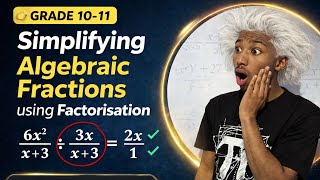
Algebraic fractions behave exactly like ordinary fractions. The one extra step is that you must factorise first — nothing can be cancelled until the top and bottom are products.
1Simplifying: factorise, then cancel FACTORS
- 1Factorise the top: x² − 9 = (x − 3)(x + 3).A difference of two squares.
- 2((x − 3)(x + 3))/(x + 3)Now top and bottom are products.
- 3Cancel the (x + 3): x − 3.
- 4x − 3, x ≠ −3The original bottom, x + 3, is 0 at x = −3, so that value is still not allowed.
The restrictions come from the ORIGINAL denominator. Cancelling a factor does not make its value legal. In (x2 − 9)/(x + 3) the bottom is 0 at x = −3, so the answer is x − 3, x ≠ −3 — and every value that makes the first denominator zero stays excluded, even when its factor disappears. In Grade 11 and 12 that restriction carries a mark.
You may only cancel factors, never single terms. In (x + 3)/3 the 3s do not cancel, because the top is a sum, not a product.
- 1Top: x² + 5x + 6 = (x + 2)(x + 3).Trinomial.
- 2Bottom: x² − 4 = (x − 2)(x + 2).Difference of squares.
- 3Cancel (x + 2): (x + 3)/(x − 2)
- 4(x + 3)/(x − 2), x ≠ ±2The original bottom x2 − 4 is 0 at BOTH x = 2 and x = −2 — the −2 must still be excluded even though (x + 2) cancelled.
2Multiplying and dividing
Multiply: factorise everything, cancel across, then multiply what is left. Divide: flip the second fraction and multiply.
- 1Flip and multiply: (x2 − 1)/x × 3x/(x + 1).Dividing by a fraction is multiplying by its reciprocal.
- 2Factorise: x² − 1 = (x − 1)(x + 1).
- 3Cancel (x + 1) and one x: 3(x − 1), x ≠ 0 ; x ≠ −1.Both denominators of the ORIGINAL question, x and 3x, are 0 at x = 0, and dividing by (x + 1)/3x also needs x ≠ −1.
3Adding and subtracting
- 1The denominators do not factorise further, so the LCD is (x + 1)(x − 1).
- 2Rewrite: (2(x − 1))/((x + 1)(x − 1)) + (3(x + 1))/((x + 1)(x − 1)).Multiply each fraction by what its denominator is missing.
- 3Top: 2x − 2 + 3x + 3 = 5x + 1.Expand and collect.
- 4= (5x + 1)/(x2 − 1)The denominator may be left factorised or expanded. The restrictions come from (x + 1)(x − 1): x ≠ ±1.
When subtracting, the minus applies to the whole numerator. a/d − (b + c)/d = (a − b − c)/d — bracket the second numerator before you subtract.
4When a denominator is a sum or difference of cubes
- 1Factorise the bottom: x³ − 8 = (x − 2)(x² + 2x + 4).A difference of two cubes.
- 2(x − 2)/((x − 2)(x2 + 2x + 4))
- 3Cancel (x − 2): 1/(x2 + 2x + 4)The numerator becomes 1, not 0 — a very common slip. The original bottom is 0 at x = 2, so x ≠ 2.
Whenever you see a cube in a denominator, expect it to factorise and cancel. That is exactly why the cube identities are taught just before this topic.
Practice exercises
Work each one out, then click to reveal the answer.
- 1Simplify: (x2 − 16)/(x + 4)
Show answer ▾Hide answer ▴
x − 4, x ≠ −4 - 2Simplify: (x2 − 25)/(x − 5)
Show answer ▾Hide answer ▴
x + 5, x ≠ 5 - 3Simplify: (x2 + 5x + 6)/(x2 − 4)
Show answer ▾Hide answer ▴
(x + 3)/(x − 2), x ≠ ±2 - 4Simplify: 6x2/3x
Show answer ▾Hide answer ▴
2x, x ≠ 0 - 5Simplify: (x2 − 1)/x ÷ (x + 1)/3x
Show answer ▾Hide answer ▴
3(x − 1), x ≠ 0, x ≠ −1 - 6Simplify: 1/x + 1/y
Show answer ▾Hide answer ▴
(y + x)/xy, x ≠ 0, y ≠ 0 - 7Simplify: 2/(x + 1) + 3/(x − 1)
Show answer ▾Hide answer ▴
(5x + 1)/(x2 − 1), x ≠ ±1 - 8Simplify: (x − 2)/(x3 − 8)
Show answer ▾Hide answer ▴
1/(x2 + 2x + 4), x ≠ 2 - 9Simplify: (x + 3)/(x3 + 27)
Show answer ▾Hide answer ▴
1/(x2 − 3x + 9), x ≠ −3
Quick Quiz
5 quick questions on what you just read. Take it when you feel ready.
Now practise it
Download Grade 10 past papers and worksheets on this topic.