π
∞
∑
∫
θ
E = mc²
y = mx+b
√
Δ
φ
∇
λ
About this video
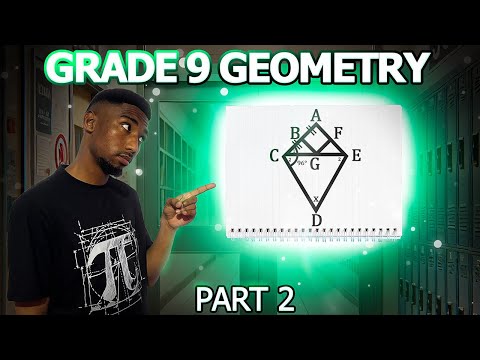
Five Grade 8 geometry questions on parallel lines and triangles: vertically opposite, corresponding, alternate and co-interior angles, the angles of a triangle, and equations built from angle facts — with the reason that earns each mark.
What it covers
- Vertically opposite angles (an X)
- Corresponding (an F) and alternate (a Z) angles — only when the lines are parallel
- Co-interior angles (a U) add up to 180°
- Two different ways to the same angle
- Equations from angle facts, then substituting in brackets
Extra worked examples
✍️ Extra example: two parallel lines are cut by a transversal. One angle is 3x + 12° and its corresponding angle is 75°. Find x.
- 13x + 12° = 75°Corresponding ∠s are equal (an F-shape) — the lines are parallel.
- 23x = 63° → x = 21°The inverse of + 12, then of × 3.
✍️ Extra example: the angles of a triangle are 2x − 20°, x + 30° and 3x − 10°. Find x and each angle.
- 1(2x − 20°) + (x + 30°) + (3x − 10°) = 180°∠s of a △ add up to 180°.
- 26x = 180° → x = 30°The numbers cancel: −20 + 30 − 10 = 0.
- 3The angles are 40°, 60° and 80°Substitute in brackets. Check: 40° + 60° + 80° = 180° ✓
Exercises to try
Work each one out, then click to reveal the answer.
- 1Alternate angles between parallel lines are 5y − 10° and 3y + 30°. Find y.
Show answer ▾Hide answer ▴
5y − 10° = 3y + 30° (alt ∠s) → y = 20° - 2Co-interior angles are 4x + 20° and 2x + 40°. Find x.
Show answer ▾Hide answer ▴
6x + 60° = 180° (co-int ∠s) → x = 20° - 3Two angles on a straight line are 2x + 25° and 95°. Find x.
Show answer ▾Hide answer ▴
2x + 25° + 95° = 180° (∠s on a str line) → x = 30° - 4Two angles of a triangle are 38° and 38°. Find the third, and name the kind of triangle.
Show answer ▾Hide answer ▴
180° − 38° − 38° = 104° (∠s of a △); two equal angles: isosceles (and obtuse) - 5Why can you NOT use corresponding angles when the two lines are not parallel?
Show answer ▾Hide answer ▴
Corresponding angles are equal only when the lines are parallel — otherwise they can be any size.
Practise this topic
Download matching Grade 8 papers and worksheets.