Find any missing angle in triangles and quadrilaterals — including isosceles, right-angled, the exterior-angle rule, solving for x, and the special quadrilaterals — each worked in full, with a worksheet.
Also known as: angle sum of a triangle · interior and exterior angles
Watch these lessons

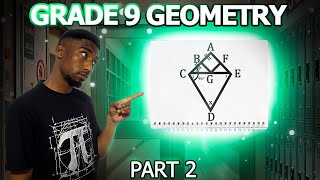


Two facts unlock most angle problems: the interior angles of a triangle add to 180°, and of a quadrilateral add to 360°. Add the special-shape properties and the exterior-angle rule, and you can solve almost any Grade 8–9 angle question. Always quote a reason — it earns a mark of its own.
1The rules to know
- Any triangle: three angles add to 180°.
- Equilateral triangle: all three angles are 60°.
- Isosceles triangle: the two base angles (opposite the equal sides) are equal.
- Right-angled triangle: one angle is 90°, so the other two add to 90°.
- Exterior angle of a triangle = the sum of the two opposite interior angles.
- Any quadrilateral: four angles add to 360°.
2Type 1: Basic triangle
- 1Angles in a triangle add to 180°.The rule (reason) to quote.
- 2x = 180° − 50° − 60° = 70°.Subtract the two known angles.
3Type 2: Isosceles triangle
- 1The two base angles are equal and share what's left after the apex.Isosceles property: base angles equal.
- 2Remaining: 180° − 40° = 140°.Triangle sum.
- 3Each base angle = 140° ÷ 2 = 70°.Split the remainder equally.
- 1Apex = 180° − 55° − 55°.The two equal base angles are given.
- 2= 70°.
4Type 3: Exterior angle of a triangle
- 1Exterior angle = sum of the two opposite interior angles.The exterior-angle rule (faster than finding the third angle first).
- 2= 65° + 40° = 105°.Reason: ext ∠ of △ = sum of opp int ∠s.
5Type 4: Solving for x in a triangle
- 1They add to 180°: x + 2x + 3x = 180.Triangle sum as an equation.
- 26x = 180 → x = 30°.So the angles are 30°, 60°, 90°.
6Type 5: Quadrilaterals
- 1All four add to 360°.Quadrilateral sum.
- 2Fourth = 360° − 90° − 100° − 85° = 85°.Subtract the known angles.
Special quadrilaterals give you extra facts: a parallelogram has opposite angles equal and co-interior angles adding to 180°; a rectangle and square have four 90° angles.
Always state your reason — 'angles in a triangle = 180°', 'isosceles', 'ext ∠ of △'. In tests, the reason is a separate mark from the answer.
Don't assume a triangle is isosceles or a quadrilateral is a square unless it is marked or stated. Use only the properties the diagram actually shows.
These are guaranteed marks once you know the rules and show reasons. Practise every type below.
Practice exercises
Work each one out, then click to reveal the answer.
- 1Two angles of a triangle (the third is 30°) are (2x + 10)° and (4x + 20)°. Determine the value of x, and hence the size of each angle.
Show answer ▾Hide answer ▴
The angles of a triangle add up to 180°, so these two add to 150° (1)
6x + 30 = 150 (1)
x = 20 (1)
The angles are 50° and 100° (1) - 2A triangle has angles 55°, 65° and x. Find x. (basic)
Show answer ▾Hide answer ▴
180° − 55° − 65° = 60° - 3A right-angled triangle has one other angle of 35°. Find the third. (right-angled)
Show answer ▾Hide answer ▴
180° − 90° − 35° = 55° - 4Isosceles triangle, apex 80°. Find each base angle. (isosceles)
Show answer ▾Hide answer ▴
(180° − 80°) ÷ 2 = 50° - 5Isosceles triangle, base angles 65° each. Find the apex. (isosceles)
Show answer ▾Hide answer ▴
180° − 65° − 65° = 50° - 6Interior angles 70° and 50°; find the exterior angle at the third vertex. (exterior)
Show answer ▾Hide answer ▴
70° + 50° = 120° - 7Triangle angles are x, x and 4x. Find x. (solve)
Show answer ▾Hide answer ▴
6x = 180 → x = 30° - 8Triangle angles are 2x, 3x and 4x. Find the largest angle. (solve)
Show answer ▾Hide answer ▴
9x = 180 → x = 20; largest 4x = 80° - 9Quadrilateral angles 120°, 80°, 70° and x. Find x. (quad)
Show answer ▾Hide answer ▴
360° − 270° = 90° - 10In parallelogram ABCD below, Â = 110°. Determine the size of x, giving a reason.
Show answer ▾Hide answer ▴
180° − 110° = 70° - 11Two angles of a triangle are equal; the third is 80°. Find each equal angle. (isosceles)
Show answer ▾Hide answer ▴
(180° − 80°) ÷ 2 = 50°
Quick Quiz
5 quick questions on what you just read. Take it when you feel ready.
Now practise it
Download Grade 8–9 past papers and worksheets on this topic.